What are Mineral Rights?
Passive Royalty Income Through
Oil & Gas Investments
What are mineral rights, and why are they one of the most powerful passive income assets available? Mineral rights represent ownership of underground resources—oil, gas, and minerals—generating royalty income without tenants, debt, or operations. This oil and gas investment guide explains how mineral rights ownership works.
War is Here.
Which Side of Inflation Are You On?
How Mineral Rights Work
Mineral rights ownership means you own the rights to the resources beneath the land – oil, gas and other subsurface minerals. When those resources are extracted:
- You receive royalty income based off the price of oil
- You are not responsible for operations
- You do not manage wells or equipment
- You collect royalty income from first well production, i.e., you will even get back pay.
- You collect non-operational revenue, i.e., your royalties are not impacted by drilling or operational expenses
No tenants.
No employees.
No day-to-day involvement.
No hassle. No headaches.
Just ownership … and MAIL CHECKS every single month for the next decade.
Financial PEACE.
Oil & Gas Investment as an Inflation Hedge
Inflation quietly destroys:
- Salaries
- Fixed income
- Savings
- Purchasing power
Mineral royalties behave differently.
As energy prices rise, royalty income often rises with them — creating a natural hedge against currency debasement and inflationary pressure.
This is why mineral ownership has historically performed well during:
- Inflationary cycles
- Currency debasement
- Geopolitical instability
- Energy supply shocks
Inflation punishes ordinary income earners and rewards mineral rights owners.

How Much Money Can you Make Owning Mineral Rights?
Sold Out Deal: Callahan Unit Martin Country, Texas
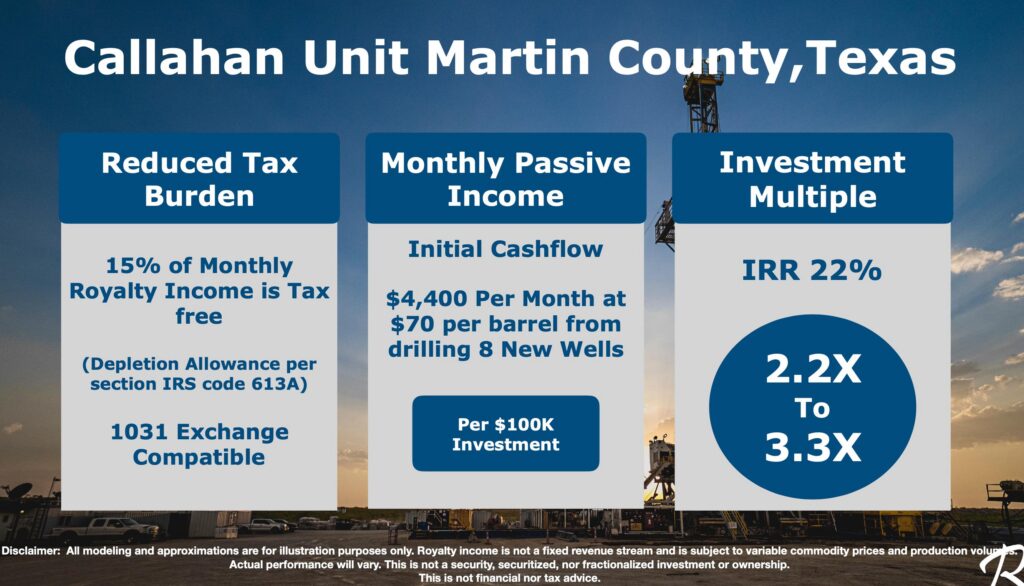
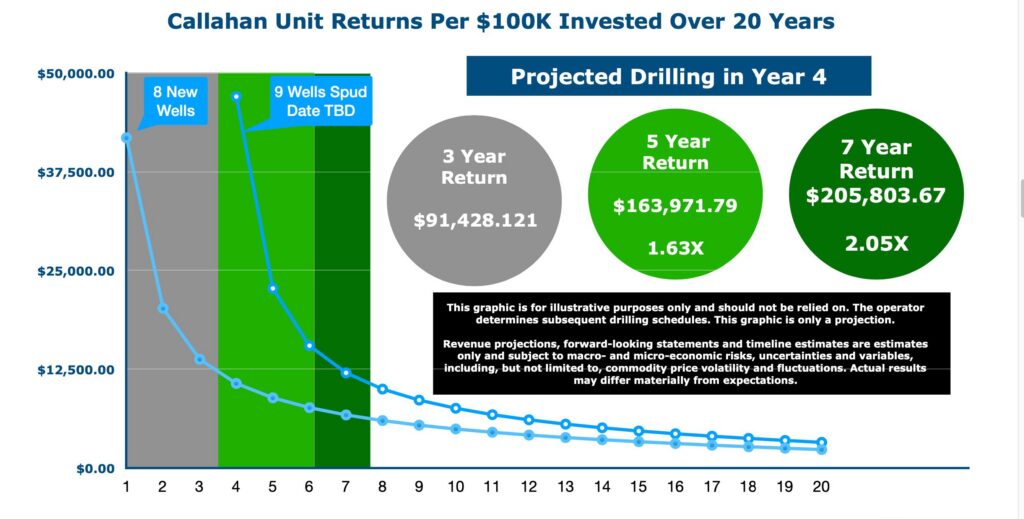
Types of Mineral Rights Investments
Not all mineral rights are structured the same way. Understanding the differences between investment types determines not just how much you earn — but how much exposure, responsibility, and risk you carry. Here’s what every serious mineral rights investor needs to know before entering a deal.
Working Interest vs. Royalty Interest
Working interest owners participate in both the upside and the cost of production. They share in revenue when oil or gas flows — but they’re also responsible for their proportional share of drilling, completion and operating expenses. Working interest can generate significant returns, but it carries operational liability and requires active management consideration.
Royalty interest owners receive a percentage of gross production revenue with no obligation to fund operations. No drilling costs. No operating expenses. No liability for what happens at the wellhead. Income flows from ownership alone — which is precisely why royalty interest is the structure Kings & Wealth focuses on for our members. It is among the most passive income structures available in any asset class.
Participating vs. Non-Participating Royalty Interest
A participating royalty interest (PRI) entitles the owner to a share of both royalty income and in some cases, bonus payments and lease negotiations — meaning the owner retains a degree of influence over how the mineral rights are leased and developed.
A non-participating royalty interest (NPRI) strips away that involvement entirely. The NPRI owner receives royalty income from production but has no rights to lease negotiations, bonus payments, or development decisions. For passive investors who want income without complexity, NPRI can be a clean and straightforward structure — provided the underlying asset is sound and the operator is credible.
Understanding Net Revenue Interest (NRI)
Net Revenue Interest is the percentage of production revenue you actually receive after all contractual obligations — royalties, overriding royalties, and other interests — have been allocated. NRI is the number that determines your real income from a producing property, and it should be the first figure verified in any mineral rights transaction.
A high NRI in a well operated by a proven multibillion-dollar producer is the combination Kings & Wealth actively sources for our members — ownership positioned for income, not speculation.

Because It’s Not Marketed. It’s Transferred.
Mineral rights are rarely advertised. Mineral rights are typically:
- Inherited
- Privately sold
- Brokered quietly
- Passed between insiders
Many investors never see mineral rights opportunities because they lack access, relationships, or the ability to determine what make an oil rights deal a successful investment.
Kings & Wealth exists to change that — by pooling intelligence, relationships and experience to source opportunities non-members would never find alone.
Selective. Strategic. Opportunistic.
We present:
- Carefully vetted
- Non-operating (no management burden)
- Evaluated for longevity and downside protection
- Positioned as part of a broader and long-term wealth and inheritance strategy
- Months away from producing oil
- Purchased beneath multibillion-dollar operators
Mineral rights are not about speculation.
They are about strong passive income over the long haul.

How to Evaluate Mineral Rights Opportunities
Most investors who lose money in mineral rights don’t lose it because the asset class failed them. They lose it because they evaluated the wrong metrics — or didn’t evaluate at all. Knowing what to look for before committing capital is what separates informed mineral rights investors from speculative ones.
These are the four metrics that matter most.

Tax Benefits of Mineral Rights Ownership
Mineral rights ownership carries a tax profile that few asset classes can match. While most investments generate income that the IRS taxes at full ordinary rates, mineral royalties come with structural advantages built directly into the tax code — advantages that wealthy families and institutions have quietly leveraged for generations.
Depletion Allowance
The IRS recognizes that a mineral resource diminishes as it is extracted. To account for this, royalty owners are entitled to a depletion deduction — typically 15% of gross royalty income — that directly reduces taxable income each year. Unlike depreciation on a physical asset, the depletion allowance requires no capital expenditure to claim. It is an automatic reduction built into mineral ownership.
Passive Income Treatment
Royalty income from mineral rights is generally classified as passive income — meaning it is not subject to self-employment tax. For high-income earners already managing active business income, this distinction alone can represent meaningful annual tax savings.
1031 Exchange Eligibility
Under specific conditions, mineral rights can qualify for a 1031 exchange — allowing investors to defer capital gains taxes by rolling proceeds from the sale of qualifying real property into a mineral rights position. This makes mineral ownership a viable destination for investors transitioning out of active real estate into a more passive income structure.

Wealth That Predates Markets. Income That Outlasts Cycles.
Mineral rights are not new. Mineral rights are timeless.
If you believe wealth should:
- Flow without friction
- Endure through cycles
- Serve your family for generations, not quarters
Then mineral rights belong in your portfolio.
What Members Get That
No One Else Does
Investors can buy mineral rights through Kings & Wealth and/or its affiliates without a membership. The deals are real, the operators are vetted, and the royalty income is yours from the moment production begins.
But membership is where the experience transforms from a transaction into a guided wealth-building process.
Here is what Kings & Wealth members receive that standalone buyers never do:
Bi-Weekly Updates
via zoom on the status of every active mineral rights position — production data, operator activity, development timelines and market conditions that affect your royalty income, delivered consistently so you are never left wondering what is happening with your investment.
Division Order Support
one of the most frustrating and misunderstood steps in the mineral rights process. Division orders determine exactly how royalty payments are calculated and distributed. Getting them right matters. Kings & Wealth tracks them down, reviews them for accuracy and ensures your ownership interest is correctly recorded before a single royalty check is issued.
First Payment Tracking
knowing when your first royalty payment will arrive is not always straightforward. Production timelines vary, operator payment cycles differ and the administrative process between ownership and first check can take months. Kings & Wealth monitors that process on your behalf and keeps you informed at every stage so there are no surprises.
Priority Access
to mineral rights opportunities with the most favorable economics — including deals with stronger NRI positions, accelerated royalty payment schedules and proximity to proven undeveloped reserves that signal near-term production upside.
A Community of Aligned Investors
who are navigating the same asset class, asking the same questions and building the same kind of long-duration, inflation-resistant wealth alongside you.
Buying mineral rights without membership is possible. Navigating the process alone — from deal evaluation through division orders through first payment — is where most first-time mineral rights investors lose confidence, make avoidable mistakes, or simply don’t know what they don’t know.
Membership exists to close that gap entirely.
Membership is:
- Application Based
- Interview Based
- Core Values Aligned
- $3,500 annually for Allocators
- $50,000 minimum investment to participate in deal opportunities
Applicants who are not approved will have membership dues refunded immediately. No exceptions.
Diversify your portfolio by joining the Kings & Wealth Club. Gain access to private equity deals ranging from 15% to 35% IRR.
There is so much more to the Kings & Wealth Club.
Frequently Asked Questions
Mineral rights are ownership rights to underground resources such as oil, gas, and other minerals. These rights are legally separate from surface rights, meaning the mineral owner can receive income from resource extraction even if they do not own or occupy the land above it.
Surface rights grant ownership and use of the land’s surface—such as farming, construction, or development. Mineral rights grant ownership of the resources beneath the surface. In many cases, surface and mineral rights are owned by different parties, each with distinct legal and financial interests.
A mineral deed is a legal document that transfers ownership of mineral rights from one party to another. It is separate from surface rights and must be properly recorded to establish legal ownership.
A deed is the legal instrument used to transfer ownership of either mineral rights or surface rights. In mineral transactions, deeds define exactly what rights are conveyed, retained, or excluded, making precision critical.
A royalty agreement is a contract that outlines the percentage of production revenue a mineral rights owner will receive from oil and gas extraction. Royalty owners do not pay drilling or operating costs and receive income based on production.
A fixed royalty is a predetermined, non-negotiable percentage of production revenue paid to the mineral or royalty owner. This percentage does not change based on market conditions or production fluctuations, providing clarity and predictability in income calculations.
NRI, or Net Revenue Interest, represents the percentage of production revenue allocated to a mineral or royalty owner after all contractual interests are applied. It determines your exact share of income from a producing property.
Important note:
In many Texas mineral rights acquisitions, drilling locations, units, and leases have already been approved by the state and granted to an operator. This means wells are established and production is known—not a speculative “drill into the unknown” strategy.
Royalty income from mineral rights varies depending on four primary factors: the royalty rate negotiated in the original lease, the volume of oil or gas produced from the well, the prevailing commodity price at the time of production, and the quality and track record of the operator extracting the resource.
There is no standard return figure — and any source that offers one without knowing the specific asset, basin, and operator should be treated with skepticism. What we can say is that well-positioned mineral rights in active producing basins have historically delivered consistent quarterly royalty income that is largely uncorrelated with stock market performance, real estate cycles, or interest rate movements.
At Kings & Wealth, we don’t present mineral rights as a get-rich-quick vehicle. We present them as what they are: a long-duration, passive income asset designed to generate reliable cash flow and compound quietly across decades — and in some cases, across generations.
Qualified applicants receive detailed deal-specific data, including production history, operator track record, and projected royalty income ranges, during the presentation process.
Mineral rights ownership is among the more resilient alternative asset structures available — but resilient is not the same as risk-free. Understanding the real risks is part of investing with the King’s DNA mindset: clarity before conviction.
The primary risks include:
Production risk — A well may produce less than projected, or decline faster than the decline curve suggested. Production is never guaranteed, and royalty income fluctuates with output.
Commodity price risk — Royalty income moves with oil and gas prices. When energy prices fall, royalty checks follow. Mineral rights are an inflation hedge over the long run, but they are not immune to commodity cycles in the short term.
Operator risk — The royalty owner has no control over how the well is operated. A poorly managed operator can reduce production efficiency, delay development, or mishandle the asset. This is why Kings & Wealth specifically targets mineral positions beneath multibillion-dollar operators with verified production histories.
Liquidity risk — Mineral rights are not a liquid asset. They cannot be sold overnight like a stock or ETF. Investors should treat mineral ownership as a long-duration position — capital committed for years, not months.
Knowing these risks is not a reason to avoid the asset class. It is a reason to be selective about which deals you enter, with whom, and through what network.
PUDs are oil or gas reserves that have been proven to exist through geological and engineering data but require additional development before production begins. These reserves represent future production potential tied to known resources.
An API (American Petroleum Institute) number is a unique identifier assigned to every oil and gas well—similar to a VIN number for a vehicle.
It consists of:
- First 2 digits: State code
- Next 3 digits: County code
- Next 5 digits: Unique well identifier
- Last 2 digits: Wellbore code
API numbers allow investors and operators to track production history, location, and regulatory data with precision.
Division orders are legal documents issued by an oil or gas operator that specify how production revenue will be distributed among mineral and royalty owners. They confirm ownership interests and payment percentages before royalties are disbursed.
The depletion allowance is a tax deduction available to mineral owners that accounts for the reduction of a mineral resource as it is extracted and sold. This deduction can significantly reduce taxable income from royalty payments, making mineral ownership more tax-efficient.
Yes, mineral rights can qualify for a 1031 exchange under specific conditions.
A 1031 exchange allows real estate investors to defer capital gains taxes by reinvesting proceeds from the sale of real property into a “like-kind” asset—such as mineral rights—without immediate tax liability. This strategy is often used to transition from active real estate management into passive royalty income.
Always consult with a qualified tax advisor to confirm eligibility and structure.
Yes. Mineral rights and royalty interests are considered among the most passive investment structures available. Owners do not manage operations, employees, tenants, or equipment. Income is generated through ownership and production alone.
Ultra-wealthy families often use mineral rights for:
- Passive income
- Inflation-resistant cash flow
- Portfolio diversification
- Generational wealth transfer
- Tax efficiency
Mineral ownership has historically endured through economic cycles and currency fluctuations.
Mineral rights opportunities are not listed on public exchanges. They are privately sourced, quietly brokered, and typically transferred within established networks of landowners, operators, and institutional buyers. Most individual investors never see a quality deal simply because they don’t have access to the relationships that surface them.
Kings & Wealth exists to solve that access problem.
Getting started begins with a membership application. Once accepted, members gain access to curated mineral rights opportunities that have been vetted for operator quality, NRI strength, production history, and deal structure — before they are ever presented to the community.
There is no requirement to invest in every opportunity. Members review each deal on its own merits and participate at their discretion. The process is designed to educate as much as it is to transact — so that every member who invests does so with full understanding of what they own and why.
Mineral rights opportunities are not listed on public exchanges. They are privately sourced, quietly brokered, and typically transferred within established networks of landowners, operators, and institutional buyers. Most individual investors never see a quality deal simply because they don’t have access to the relationships that surface them.
Kings & Wealth exists to solve that access problem.
Getting started begins with a membership application. Once accepted, members gain access to curated mineral rights opportunities that have been vetted for operator quality, NRI strength, production history, and deal structure — before they are ever presented to the community.
There is no requirement to invest in every opportunity. Members review each deal on its own merits and participate at their discretion. The process is designed to educate as much as it is to transact — so that every member who invests does so with full understanding of what they own and why.
Important Disclosure
This publication and any related materials (collectively, the “Information”) are provided by Kings & Wealth solely for general informational and educational purposes. The Information is not intended to constitute, and does not constitute, investment, legal, tax, accounting, or other professional advice. Nothing contained herein should be relied upon as a basis for making any financial, investment, or legal decision. Readers are encouraged to consult their own qualified professional advisors prior to taking any action.
➢ The Information is based on sources believed to be reliable; however, Kings & Wealth makes no representation or warranty, express or implied, as to the accuracy, completeness, timeliness or reliability of the Information. The Information is provided “as is” and may be subject to change without notice.
➢ Certain statements contained herein may constitute forward-looking statements, which are inherently speculative and subject to known and unknown risks, uncertainties and other factors that may cause actual results or outcomes to differ materially from those expressed or implied. Many of these factors are beyond the control of Kings & Wealth and its affiliates. There is no assurance that any expectations, projections or assumptions will prove accurate.
➢ Real estate, mineral interests, and self-directed qualified plans involve risk and are subject to a wide range of variables, including market conditions, operational factors, regulatory changes, commodity price volatility, and production variability. Royalty income and other cash flows are not guaranteed and may vary significantly over time. Past performance is not indicative of future results. Deeded mineral rights are real property interests and are not securities; however, certain related structures or transactions may be subject to applicable securities laws.
➢ Any references to potential transactions, assets, or structures are provided solely for illustrative and informational purposes. Such references do not constitute an offer to sell, a solicitation of an offer to buy or a recommendation regarding any investment, transaction or strategy. No transaction will be offered or consummated except pursuant to definitive documentation, if applicable, and subject to independent evaluation by the parties involved.
➢ Kings & Wealth, together with its officers, directors, employees, consultants, and agents, expressly disclaims any and all liability for any loss or damage arising out of or in connection with the use of, or reliance upon, the Information, including without limitation any errors or omissions.
➢ Nothing contained herein should be construed as creating any fiduciary duty, advisory relationship, or obligation on the part of Kings & Wealth or any of its affiliates. Each reader is solely responsible for conducting their own independent analysis, due diligence and assessment of any matter referenced herein.
➢ By accessing or using this Information, you acknowledge and agree that Kings & Wealth and its affiliates shall have no liability for any direct, indirect, incidental, consequential or special damages arising from your reliance upon or use of the Information.