Algorithmic Energy Trading Strategy That Outperforms The S&P By 7X
Algorithmic energy trading transforms how investors approach volatile crude oil markets. Oil markets are driven by geopolitics, supply shocks, policy decisions and extreme volatility.
Our partner proprietary trading strategy combines automated signals with experienced human oversight—managing risk with discipline, not emotion. This page explains our methodology and how qualified investors can access this crude oil trading strategy.
What is Algorithmic Energy Trading?
Algorithmic energy trading analyzes big data to identify trade set ups and execute trades in commodities markets — removing the hesitation, emotion and timing errors that cost human traders in fast-moving conditions. In crude oil markets, speed and discipline aren’t advantages. They’re survival requirements. Oil prices move on WAR breakouts, presidential tweets, the closure of the Strait of Hormuz, attacks on US bases & oil refineries, OPEC decisions, geopolitical shocks and supply and transportation disruptions — often within minutes. By the time a human trader processes the signal and acts, the opportunity has already subsided.
Algorithmic systems don’t hesitate. They execute.
But not all algorithmic systems are built the same — and in crude oil, the difference in architecture is the difference between a system that holds up under volatility and one that breaks precisely when it matters most.
Most trading algorithms are built on probability models — statistical frameworks that assume markets follow predictable, bell-curve distributions. In stable conditions, they perform. In chaotic ones — the exact conditions that define oil markets — they misread noise as signal and fail when the stakes are highest.
Our partner proprietary trading algorithm is built differently
The algorithm applies Digital Signal Processing — an engineering discipline originally developed for radar and communications — to filter meaningful price signals from market noise in real time. Rather than predicting what the market will do, we engineer a system that operates within what the market actually is: chaotic, fractal and non-linear.
The algorithm not only identifies opportunistic setups with military tech precision but sends out instantaneous trade signals for human execution to get ahead of the trajectory. Human oversight then governs risk. Neither operates without the other.
The result is an institutional-grade approach to crude oil trading — systematic enough to remove emotional error, adaptive enough to function when markets stop behaving normally.
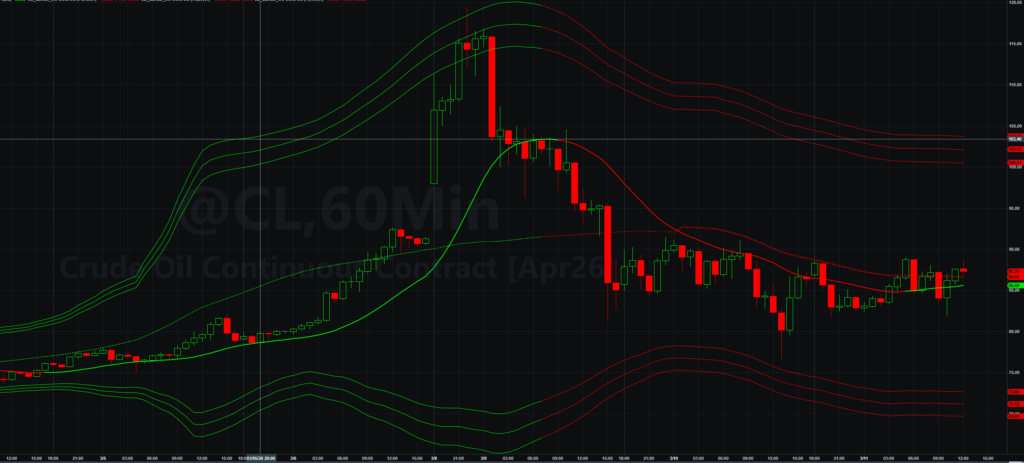
Automation Generates Trade Opportunities. Humans Govern Risk.
Our approach is intentionally hybrid:
- Algorithms generate trade opportunities
- Humans establish automated protocols for stop losses, circuit breakers and capital deployment limits
- Automation monitors volatility spikes, news shocks and abnormal behavior and identifies trade opportunities and set ups
- Risk controls are designed to override human discretion
Humans enforce algo-generated guardrails when conditions change.
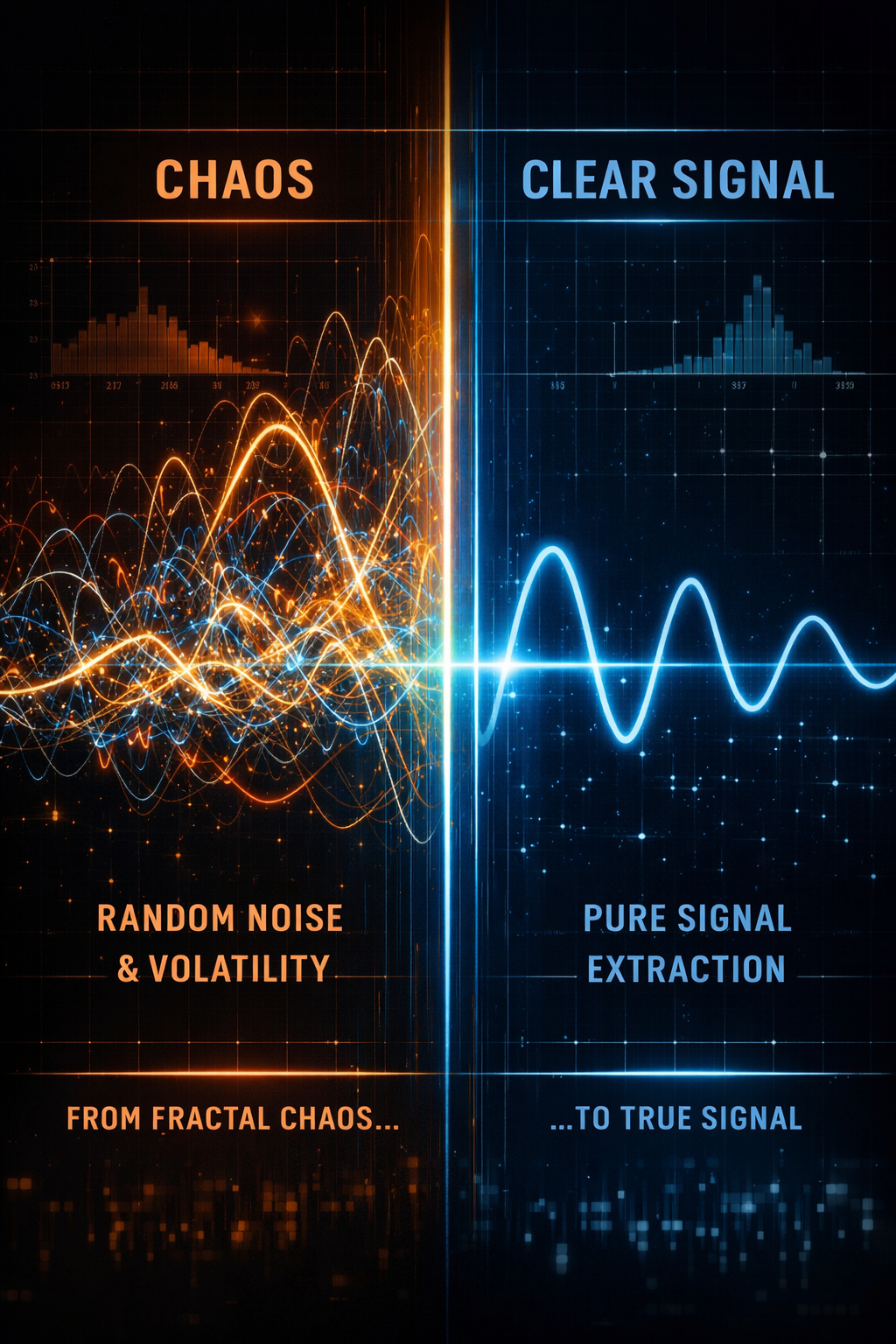
Why Many Algorithms Struggle In Volatile Markets — and How We Approach It Differently
Most trading algorithms rely on probability models—specifically Probability Density Functions. These models assume markets behave like most natural data: predictable, stable and distributed neatly along a bell curve.
When markets stop behaving normally, probability density functions systems can misinterpret noise as a signal—and may underperform precisely when volatility matters mosts.
That assumption fails in real markets.
Oil markets are chaotic, fractal and non-linear. Volatility clusters. Rare events happen often. There is no stable probability curve to model.
Our algorithm looks for extremities within the transformation of erratic data since the data does not conform to a normal distribution. Digital signal processing transforms this data into a usable distribution.
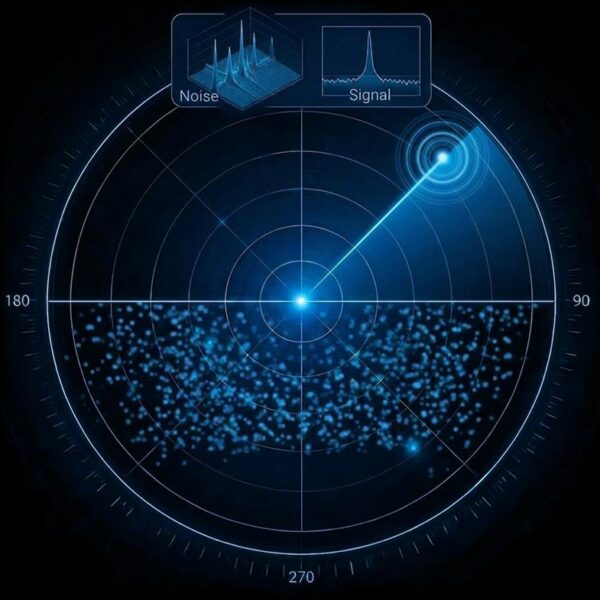
Our Algorithm operates like radar. Scanning through the noise seeking the radar echo or “target” aka blip, which is the extremity and deviation of the price, which when too far from its transformed mean, signals an opportunity to short or go long.
The Market Isn’t a Math Problem. It’s an Engineering Problem.
Instead of forcing markets into probability models that don’t fit, we treat price action as what it truly is: a signal moving through noise.
Our partner strategy applies Digital Signal Processing (DSP) techniques—originally developed for radar and communications systems—to
- Filter out random market noise
- Seeking out, analogously speaking, “radar echo or target” aka blip that will translate into meaningful price behavior or downward or upward trajectory signals
- Adapt in real time as conditions change sharply
In simple terms:
- Most algorithms guess using probabilities
- We filter signals from chaos
This allows the system to remain functional during volatility—exactly when probability-based models fail and miss the mark completely.
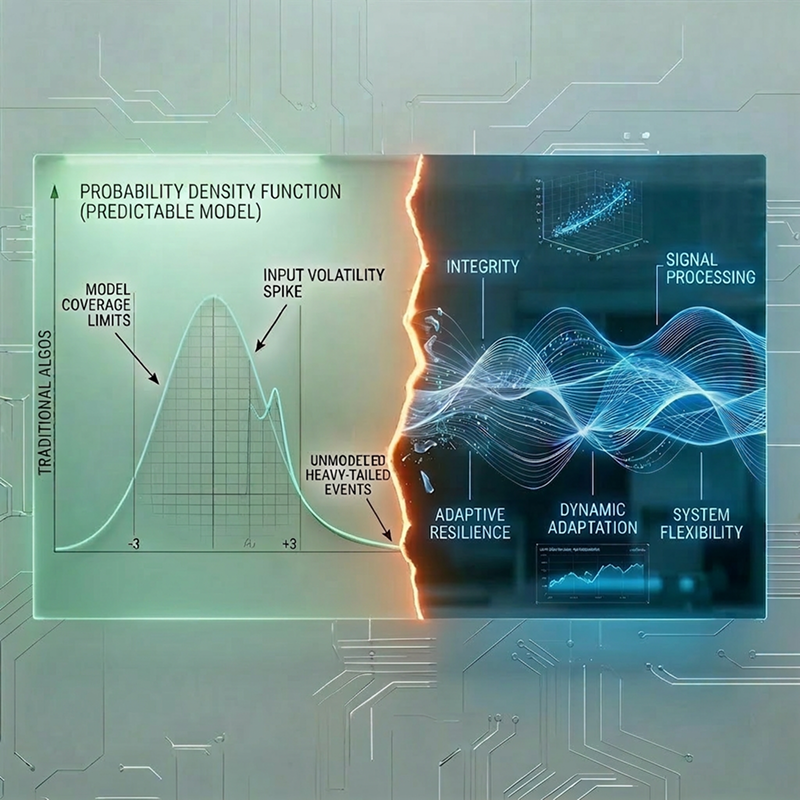
Traditional Probability Density Functions-Based Algorithms
- Assume predictable patterns
- Break during volatility
- Backward-looking
- Fragile under stress
Comping our trading partner’s algorithm to other market quant systems, our DSP-based system
- Accepts chaos
- Designed for volatility
- Real-time adaptive
- Built to function under stress
Most systems try to predict the market. Our system operates and flows with the market, even in times of volatility and chaos.
Our Systematic Trading Approach
1. Signal Identification
- The Algorithm operates like radar. Scanning through the noise seeking the radar echo or "target" aka blip, which is the extremity and deviation of the price, which when too far from its transformed mean, signals an opportunity to short or go long.
2. Human Execution Based Off Signals
- Trades are executed by humans systematically based off the automated signals to remove emotional and timing errors.
3. Risk Management Framework
- Position sizing, exposure limits, drawdown thresholds and event controls are continuously monitored—with human oversight during abnormal conditions.
Built Around Capital Preservation. Reasons for Outsized Outperformance
Risk management is the framework—not an afterthought. Parameters dictated by our partner, the algo inventor:
- Exposure limits no greater than 3% per trade, i.e., not more than 20% of the entire capital will be at risk or deployed in aggregate in the market at any one point in time. Currently, 8% is the limit due to the ongoing war.
- Position sizing relative to market and margin price.
- Liquidity and spread filters.
- Circuit-breaker protocols.
- No trades are made for the sake of trading, only to exploit opportunities identified by the algo.
No system eliminates risk. This one is designed to eliminate human discretionary failures.
Exceptional track due to
- Exceptional experience and skill of our partner, a senior trader with over fourteen years’ experience, and currently leading and managing two commodity trading desks in Houston.
- He is also the inventor of the algorithm as well as the proprietor of the trading software.
Exceptional Outcome: the strategy has been consistently returning min. 5% per month for our partner’s institutional clients
The Mind Behind the Machine
The engineer who built this system didn’t come from Wall Street. He came from a problem.
While pursuing degrees in computational finance and economics at the University of Pittsburgh, he recognized a fundamental flaw in how markets were being modeled — traditional time series analytics and mathematical frameworks were being applied to data that was never stable enough to support them. Rather than work around the limitation, he helped build a solution: co-founding the applied signal processing division of the university’s econometrics lab, where the foundation of this approach was first developed.
In 2014, he launched Sardonyx Capital — not to trade, but to test. What followed was years of live market validation, iterating the algorithm against real crude oil futures data until the system earned its place in serious institutional circles.
Today he manages two energy trading floors in Houston, Texas. That’s not a credential on a slide deck. It’s proof that the algorithm has been trusted — repeatedly, at scale — by the kind of operators who can’t afford to get it wrong.
This is not a theory. It’s a track record.
Who This Strategy Serves
Best fit for:
- Large capital investors
- Institutional commodities trading Firms
- Oil and Gas operators seeking hedging strategies
- High-net-worth individuals seeking both liquidity and larger returns
- Investors who want access to an institutional-grade returns
How to Learn More
- Access to the Kings & Wealth crude oil algorithmic trading strategy begins with a single conversation.
- This is not an open platform. Every participant goes through a structured review process — not to create unnecessary friction, but to ensure the strategy is a genuine fit for your capital profile, risk tolerance, and investment objectives. We protect both the integrity of the system and the investors inside it.
- Here's how the process works:
Step 1 — Request a Presentation
- Click “Request a Presentation” to access the presentation calendar. Tell us briefly about your capital position and what you're looking to accomplish.
Step 2 — Private Presentation
- Qualified applicants receive a private walkthrough of the system architecture, risk governance framework, and performance data — everything you need to evaluate the strategy on its merits.
Step 3 — Suitability Review
- We confirm alignment between your investor profile and the strategy parameters before any capital commitment is discussed. There's no obligation at any stage. If it's not the right fit, we'll tell you directly.
Risk Disclosures
Trading futures, options, and leveraged instruments involves substantial risk and may not be suitable for all investors. You may lose more than your initial investment. Past performance is not necessarily indicative of future results.
Frequently Asked Questions
Crude oil algorithmic trading uses computer-driven systems to analyze price signals and execute trades in oil futures markets automatically — removing emotional decision-making and timing errors from the process. Unlike manual trading, algorithmic systems respond to market conditions in milliseconds, enforcing consistency and discipline that human traders cannot maintain under pressure.
Manual trading relies on a human reading the market and deciding when to act — a process vulnerable to hesitation, emotion, and cognitive bias. Algorithmic trading defines the rules in advance and executes them precisely, regardless of market noise or short-term volatility. In crude oil specifically, where prices can shift dramatically on a single geopolitical headline, that consistency is a structural advantage.
Most trading algorithms rely on probability density functions — statistical models that assume markets behave predictably. Crude oil doesn’t. Our system applies Digital Signal Processing, an engineering framework originally developed for radar, to filter meaningful price signals from market chaos in real time. Rather than predicting what oil prices will do, we engineer a system designed to operate within what oil markets actually are: volatile, non-linear, and event-driven.
All trading involves risk, and crude oil futures are among the more volatile instruments available. Our system is built around risk governance first — position sizing is capped at no more than 3% exposure per trade, with circuit-breaker protocols, liquidity filters, and continuous human oversight during abnormal market conditions. No system eliminates risk. This one is designed to eliminate the discretionary human errors that amplify it.
Returns vary depending on market conditions, capital deployed, and risk parameters. We don’t publish projected return figures — past performance in commodities trading is not indicative of future results. What we can speak to is the discipline of the system: consistent rule-based execution, defined downside limits, and a process that doesn’t chase performance or override guardrails to recover losses. We share detailed performance data with qualified applicants during the presentation process.
This strategy is built for large capital investors, high-net-worth individuals, institutional commodities trading firms, and oil and gas operators seeking systematic hedging strategies. It is not designed for retail traders or speculative capital. Participation requires accredited investor status and a suitability review prior to access.
Minimum investment details are provided during the application and presentation process, as position sizing and entry points are structured relative to each participant’s capital profile and risk tolerance. To begin the conversation, request a presentation through our membership application.
utomation handles signal identification and trade execution — the parts of the process where speed and consistency matter most. Human oversight monitors for abnormal market conditions: volatility spikes, geopolitical shocks, or events that fall outside the system’s defined parameters. When those conditions emerge, human governors enforce risk controls and circuit breakers rather than allowing the algorithm to continue operating in an environment it wasn’t designed for. Humans don’t override the system to chase returns. They protect it from conditions that exceed its guardrails.
Most algorithmic systems struggle in volatile markets precisely because they’re built on probability models that assume stability. Our DSP-based approach is designed for volatility — it treats erratic price behavior as data to be filtered rather than an anomaly to avoid. The system scans for meaningful deviations from a transformed price mean, identifying opportunities that emerge specifically during the kind of extreme market conditions where probability-based models tend to break down.
Access is reserved for members only. The Kings & Wealth membership process is application-based, includes a suitability review, and begins with a private presentation covering the system architecture, risk framework, and performance data. To request a presentation, apply through our membership page.